

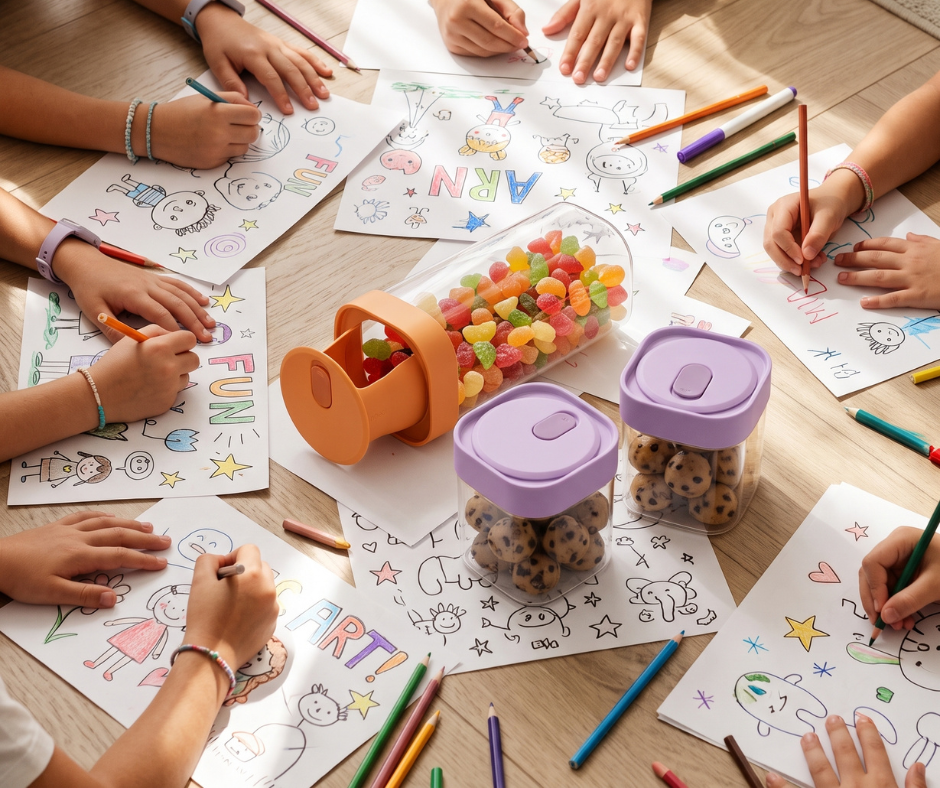
Some of the best product ideas begin with a simple question:
Why does it have to work this way?
For Popout, that question started with something as ordinary as a jar.
During a visit to a trade show in Frankfurt, our team came across an unusual Mason jar with a side-opening design. It challenged one of the most familiar objects in the kitchen and made us think differently about what a container could do.
A jar didn't have to simply store something.
It could become part of the way we use it.
That observation eventually became the starting point for Popout.
Why Do We Always Reach Into the Jar?


Think about the last time you shared chips, popcorn, nuts, or candy with friends.
Someone opens the container. Everyone reaches inside. Fingers get covered in oil or seasoning. Crumbs fall back into the jar. And when you try to pour directly from a bag or container, it's easy to pour too much.
We had become so accustomed to this experience that we rarely questioned it.
So we did.
What if you didn't have to reach into the container at all?
Instead of designing another jar with a better-looking lid, we began exploring an entirely different way to access what's inside.
The idea was simple: create an opening on the side that could be opened when you wanted to pour and closed when you wanted to store.
Simple idea. Much harder engineering.
Reinventing the Lid

Traditional jar lids are passive. Their primary job is to open, close, and protect what's inside.
We wanted the Popout lid to do more.
The goal was to create a lid that could transform from a compact storage form into a functional pouring opening—and then return smoothly to its original shape.
Our first concepts explored an external telescoping structure. Functionally, it had potential, but the mechanism protruded too far from the jar and compromised the clean appearance we wanted.
So we went back to the drawing board.
We experimented with a rotating structure. This solved some problems but introduced new ones: more components, more complexity, and an interaction that didn't feel as intuitive as it should.
Eventually, we began experimenting with silicone.
Its flexibility gave us something rigid structures couldn't: the ability to compress, fold, expand, and return to shape within a very limited amount of space.
That became the foundation of the Popout lid.
The Challenge Hidden Inside a Simple “Pop”

What looks like one simple movement required countless small adjustments.
Silicone is flexible by nature—and that's both its greatest advantage and one of its biggest engineering challenges.
When you press the Popout opening, the material needs to fold in the right direction. It needs to feel smooth rather than unpredictable. When closed, the surfaces need to fit together closely to help protect the food inside from moisture.
The geometry of the folding structure became critical.
We repeatedly adjusted the contours, folding direction, and thickness of the silicone until the movement felt right.
Even the thickness couldn't be arbitrary.
Make the silicone too thin and it can affect the stability of the fold and the quality of the seal.
Make it too thick and the opening becomes harder to operate.
Finding the right balance between flexibility, sealing, durability, and feel became one of the most important parts of Popout's development.

Why Is It Called “Popout”?
The name came naturally from the experience of using the lid.
We were inspired in part by the satisfying interaction of opening a pull-tab can—that little movement and recognizable sound that tells you something has opened.
With Popout, pressing the silicone structure creates its own satisfying “pop” as the opening transforms from closed to ready-to-pour.
Pop it open.
Pour.
Push it closed.
That tiny interaction eventually gave the product its name:
Popout.
Materials With a Purpose

The container itself needed the same level of consideration as the lid.
We chose borosilicate glass for its clarity, durability, and resistance to absorbing odors. You can immediately see what's inside, while the material doesn't interfere with the smell or flavor of your food.
For the lid, we selected food-grade silicone suitable for food contact and repeated everyday use.
Together, glass and silicone allowed us to create a product that feels at home on a kitchen counter while still performing as an everyday storage container.
The result isn't technology for technology's sake.
Every material exists for a reason.
Designed Around the Moments We Share
One of our favorite ways to imagine Popout is during movie night.
There's a jar of popcorn, crackers, candy, or nuts sitting between family and friends.
Instead of everyone reaching inside, you simply pop open the side, tilt the jar, and pour.
The same interaction works at an office snack station, during an afternoon break with the kids, or when friends gather around the table.
Those ordinary moments became central to the way we designed Popout.
Because ultimately, we weren't trying to reinvent snacking.
We were trying to remove a few small frustrations from it.
From Storage to Interaction

Looking back, the Frankfurt inspiration taught us something that has stayed with us throughout the development process:
Even the most familiar objects can be questioned.
A jar doesn't have to be something you open, reach into, and close again.
A lid doesn't have to be just a flat piece that keeps food inside.
And storage doesn't have to stop at storage.
Popout brings storage, pouring, and sharing into one simple interaction.
We're still thinking about where this idea could go next—from making the pop-out movement even smoother and reducing the overall weight to exploring entirely new ways a side-opening structure could interact with different foods and containers.
But Popout begins with something much simpler:
A jar.
A different way to open it.
And a better way to share what's inside.
Share More. Mess Less.
Pop it. Pour it. Share it.


Leave a comment
All comments are moderated before being published.
This site is protected by hCaptcha and the hCaptcha Privacy Policy and Terms of Service apply.